


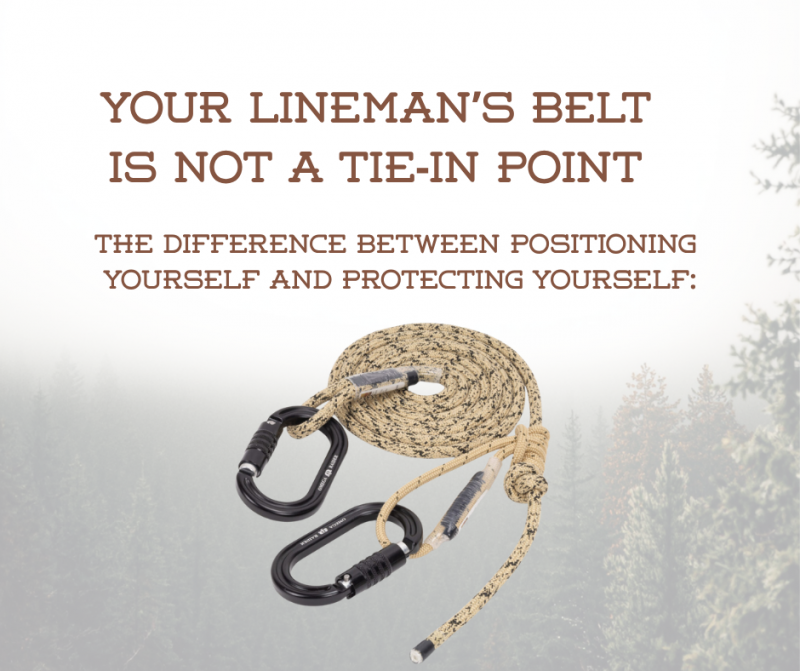
The Difference Between Positioning Yourself and Protecting Yourself:
In the saddle hunting world, few pieces of equipment are discussed more casually than the so called lineman’s belt. Unfortunately, that terminology and the mindset that often comes with it may be contributing to unsafe practices and confusion about what this equipment is actually designed to do. Somewhere along the way, many hunters began treating their lineman’s belt as though it were their primary safety system. That deserves a serious conversation.
The first step is changing how we talk about the equipment itself. Rather than calling it a lineman’s belt, we should be referring to it by its proper function: a work positioning lanyard. That distinction is more than semantics. Words shape understanding, and understanding shapes behavior.
A work positioning lanyard is exactly what the name implies: equipment intended to help stabilize and position the user while performing a task. In saddle hunting, that task may involve climbing, hanging sticks, adjusting equipment, or maintaining body position against the tree. Its purpose is to provide positioning, stability, and controlled movement while working. What it is not designed to do is replace the concept of a proper tie in point.
This misunderstanding often becomes apparent when discussing attachment height and anchor placement. Most work positioning lanyards are connected at or near waist level, creating an attachment point that is beside the user rather than above them. While this setup may provide stability and support during climbing or setup, it does not offer the same level of fall prevention as an overhead attachment.
The physics are difficult to ignore. When an attachment point is located beside or below the user, there is generally greater opportunity for movement if footing fails, body position changes unexpectedly, or slack develops in the system. This can lead to increased fall distance and a more dynamic loading event before the system becomes fully engaged. Simply put, the lower the attachment point, the greater the potential for unwanted movement.
The goal of a climbing system should not be merely surviving a fall after it occurs. The real objective should be preventing that fall or minimizing its consequences before it ever develops into a serious incident. This is why overhead attachment points have long been emphasized across professional climbing disciplines.
Rope access technicians, arborists, and other professional climbers learned this lesson decades ago. Entire industries built around climbing and fall protection place heavy emphasis on overhead tie in points because they generally provide better stability, reduced fall potential, improved system management, and less opportunity for uncontrolled movement. These principles are not theoretical opinions or marketing claims. They are the result of real world experience and a deep understanding of climbing systems.
Saddle hunting has evolved tremendously over the years. Equipment continues to improve, climbing methods are becoming more refined, and knowledge is spreading faster than ever before. That progress is encouraging, but with innovation comes responsibility. As a community, we should be willing to challenge terminology and techniques that may unintentionally create confusion or encourage poor habits.
This is not an argument against work positioning lanyards. They are incredibly useful tools and play an important role in many climbing systems. However, usefulness should not be confused with purpose. A work positioning lanyard is designed to position you while you work. It is not a substitute for thoughtful tie in strategy or the benefits of an attachment point located above the user.
At the end of the day, language matters because safety depends on understanding. The term lineman’s belt often sounds like a singular piece of life-support equipment. Work positioning lanyard communicates something far more accurate: a tool designed to assist with positioning, not replace sound climbing practices.
Because the truth is simple:
Your work positioning lanyard is not your tie in point. And above you is generally safer than beside you.